Taking Our Own Website to a 99+ PageSpeed Score Through SEO & Technical Optimization
We treated our own website as the first proof of what we deliver, optimizing for speed, search visibility, and the technical foundations that modern AI search engines rely on.
99/100
Mobile Performance
100/100
Desktop Performance
100/100
SEO Score
The Client
Innovex Solution's own website is both our storefront and our proof of work. Before this optimization pass, the site, like most growing agency websites, carried unoptimized images, render-blocking scripts, and analytics tags loading eagerly on every page, all of which quietly worked against speed and search visibility.
The Challenge
Slow-loading pages hurt two things at once: user experience and Google rankings, since Core Web Vitals are a direct ranking factor. On top of that, with AI search tools like ChatGPT and Perplexity increasingly answering queries directly, a site also needs the right technical foundations, structured data, semantic HTML, and clean content, to be understood and referenced by these systems, not just by traditional search crawlers.
The Solution
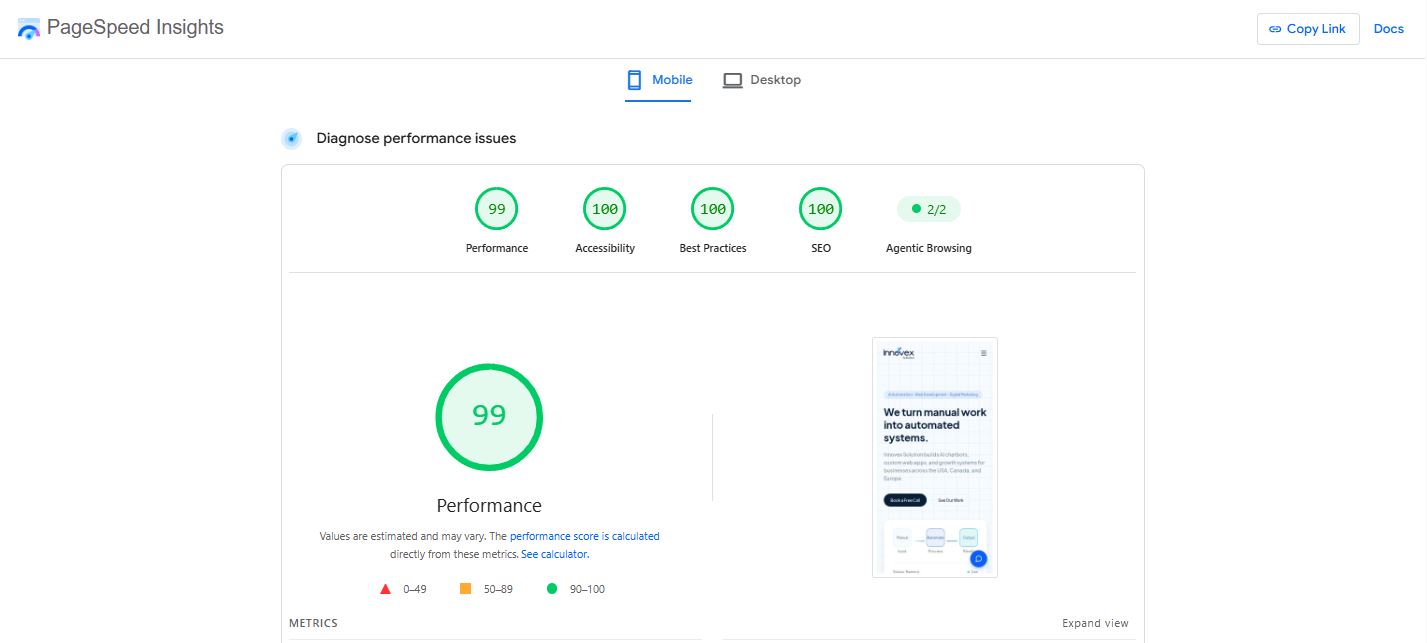
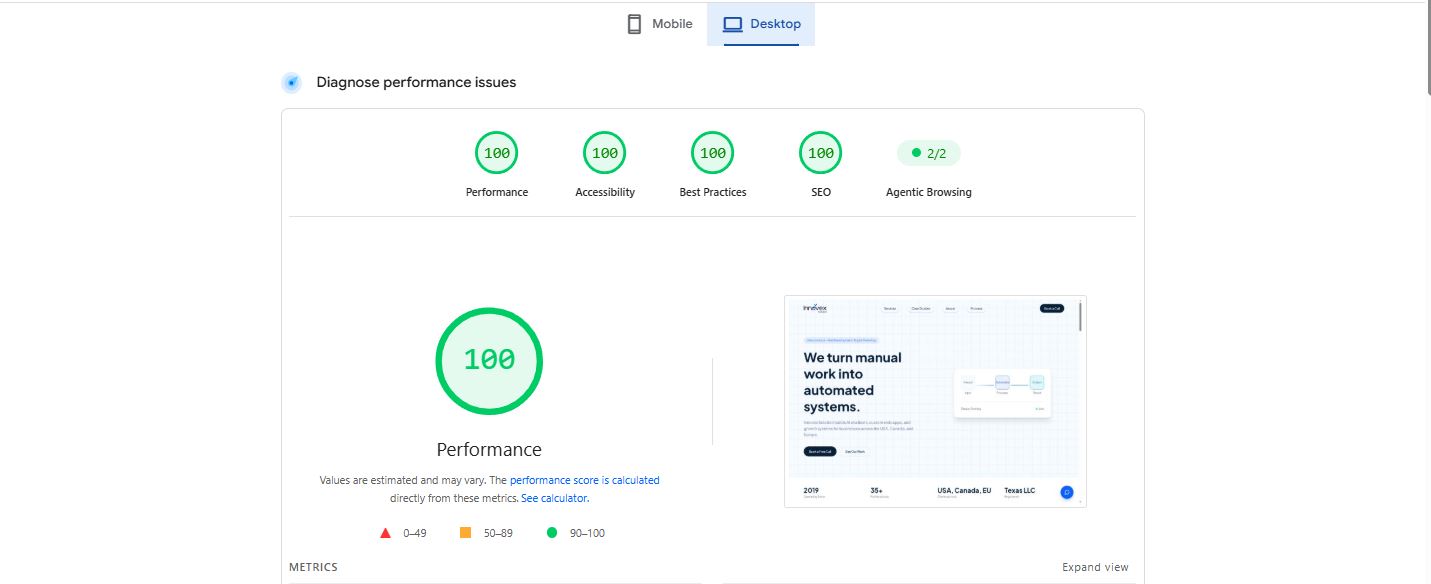
We ran a full technical SEO and performance audit on our own site, then fixed every meaningful bottleneck: compressed and correctly sized images, deferred non-critical scripts like Google Analytics so they no longer blocked the initial render, and verified structured data was in place site-wide. The result was measured directly with Google PageSpeed Insights, the same tool Google uses internally to evaluate Core Web Vitals.
The Proof
Measured directly with Google PageSpeed Insights.
Mobile
Desktop
How It Works
From an unoptimized site to a near-perfect score.
Technical Audit
Ran the site through Google PageSpeed Insights and Lighthouse to identify every performance bottleneck: oversized images, render-blocking resources, and unnecessarily eager third-party scripts.
Image & Asset Optimization
Resized and compressed images to match their actual display dimensions instead of serving oversized files, cutting unnecessary download weight across every page.
Script Loading Strategy
Changed how third-party scripts like Google Analytics load, deferring them until after the page is interactive, so they no longer compete with content for the critical rendering path.
GEO Foundations
Implemented structured data (JSON-LD Organization schema) and semantic, well-structured HTML, the technical groundwork that helps AI search engines like ChatGPT, Perplexity, and Gemini understand and accurately reference a business, in addition to traditional Google indexing.
Tools Used
Common Questions
SEO & GEO, explained.
What is SEO and why does it matter for a business website?
SEO, or Search Engine Optimization, is the practice of improving a website so it ranks higher in Google search results and loads fast enough to satisfy both users and Google's ranking algorithm. A well-optimized site attracts more organic traffic without paying for ads.
What is GEO and how is it different from SEO?
GEO, or Generative Engine Optimization, is the practice of structuring a website's content so AI systems like ChatGPT, Perplexity, and Google Gemini can accurately read, understand, and reference it when answering user questions. It relies on structured data, semantic HTML, and clear, well-organized content, working alongside traditional SEO rather than replacing it.
What PageSpeed score did Innovex Solution achieve on its own website?
Innovex Solution achieved a 99 out of 100 Performance score on mobile and a 100 out of 100 Performance score on desktop, measured directly with Google PageSpeed Insights, along with 100 out of 100 scores in SEO, Accessibility, and Best Practices.
What technical changes improve a website's PageSpeed score?
The most impactful changes typically include compressing and correctly sizing images, deferring non-critical third-party scripts such as analytics tags, and eliminating render-blocking resources so the browser can display content faster.
Note: the GEO work described here reflects the technical foundations implemented, structured data and semantic markup, rather than measured AI search ranking results, which we are actively tracking as this space matures.